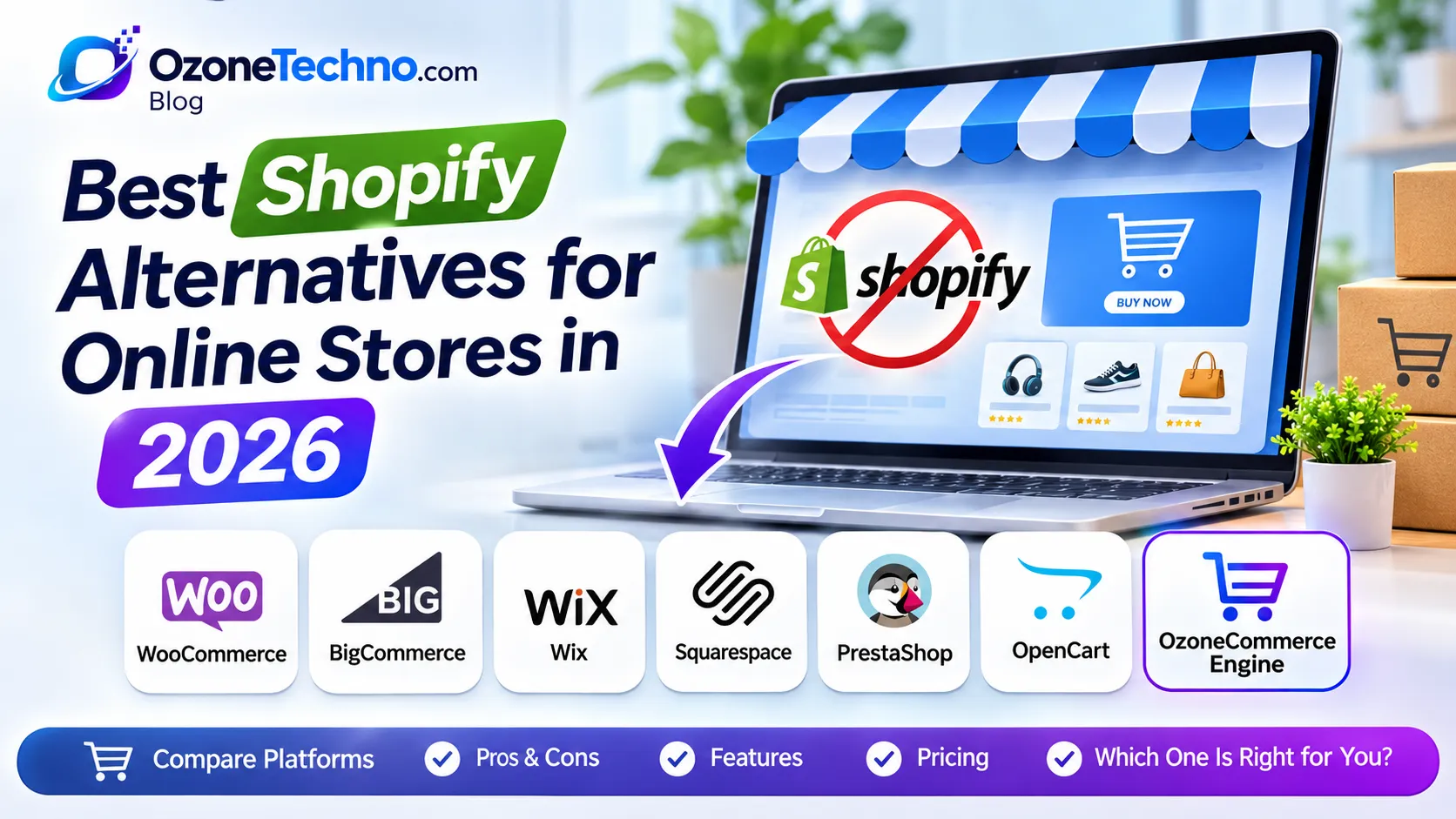
Best Shopify Alternatives for Online Stores in 2026
Shopify is one of the most popular platforms for building and managing an online store. It provides hosting, store management, payment integrations, themes, and a large app ecosystem, making it convenient for businesses that want to start selling online without managing their own server infrastructure.
However, Shopify isn't the perfect solution for every business.
Monthly subscription costs, paid applications, payment processing charges, customization requirements, and platform limitations can make business owners consider other eCommerce solutions. As an online store grows, choosing the right platform becomes even more important because platform costs and operational requirements can affect long-term profitability.
Fortunately, there are several Shopify alternatives available in 2026. From open-source platforms such as WooCommerce and PrestaShop to hosted solutions such as BigCommerce and Wix, businesses have more options than ever.
In this guide, we'll explore some of the best Shopify alternatives for online stores in 2026, compare their features, and help you decide which platform is suitable for your business.
Why Look for a Shopify Alternative?
Shopify offers a convenient way to launch an online store, but its subscription-based model and ecosystem may not suit every business.
Here are some common reasons why store owners explore alternative eCommerce platforms.
1. Monthly Subscription Costs
Shopify requires a monthly subscription to operate an online store. Depending on your selected plan, business requirements, and additional services, the overall cost can increase over time.
Businesses that want to minimize recurring software expenses may prefer open-source or custom-built eCommerce solutions.
2. Additional App Expenses
Shopify has a large app marketplace, but some advanced features require paid applications.
For example, businesses may need additional apps for:
Advanced product filtering
Custom checkout features
Marketing automation
Courier and shipping integrations
Subscription management
Advanced reporting
These additional expenses should be considered when calculating the total cost of operating an online store.
3. Payment Processing and Transaction Fees
Payment processing charges are an important consideration for every online retailer.
Depending on the country, payment provider, and Shopify subscription, additional transaction fees may apply when using third-party payment providers. Payment gateways may also charge their own processing fees.
Businesses should compare the complete payment cost rather than looking only at monthly platform subscriptions.
4. Customization Requirements
Shopify provides themes, apps, and customization options. However, businesses with specialized workflows or unique operational requirements may need additional development.
A custom eCommerce platform can offer more flexibility when a business requires specific order management, shipping, pricing, or integration features.
5. Business Ownership and Control
Some businesses prefer greater control over their website infrastructure, customer data, software, and development decisions.
Open-source and custom-built platforms can provide different levels of control, depending on their hosting, licensing, and development arrangements.
7 Best Shopify Alternatives for Online Stores in 2026
Let's explore seven alternatives, including their key features, advantages, disadvantages, and the types of businesses they are suitable for.
1. WooCommerce – Best for WordPress-Based Online Stores
WooCommerce is an open-source eCommerce platform built for WordPress. It allows businesses to transform an existing WordPress website into a fully functional online store.
It is particularly popular among businesses that want control over their website design, products, checkout, and integrations.
Unlike hosted platforms, WooCommerce does not charge a monthly software subscription for its core plugin. However, store owners need to arrange hosting, domain registration, security, backups, and any premium extensions they require.
Key Features:
Open-source eCommerce software
Product and inventory management
Flexible payment gateway integrations
Shipping and tax configuration
Extensive themes and extensions
WordPress blogging and SEO capabilities
Customizable checkout and storefront
Advantages:
No subscription fee for the core software
Extensive customization possibilities
Large WordPress community
Control over hosting and website data
Suitable for content-driven online stores
Disadvantages:
Requires WordPress management and maintenance
Hosting and premium extensions can increase costs
Plugin compatibility and updates need attention
Performance depends on hosting and website configuration
Best For: Small and medium-sized businesses, WordPress users, bloggers, and retailers who want flexibility and control over their online stores.
Website: https://woocommerce.com/
2. BigCommerce – Best for Growing Online Businesses
BigCommerce is a hosted eCommerce platform designed for businesses that need built-in selling tools and the ability to manage a growing product catalog.
It offers a range of eCommerce features without requiring store owners to manage their own web server.
BigCommerce is worth considering for businesses that want a hosted solution but need advanced commerce capabilities.
Key Features:
Hosted online store management
Product and inventory management
Multi-channel selling capabilities
Payment provider integrations
Shipping and tax tools
B2B commerce capabilities
Customizable storefronts
Advantages:
Hosting is included
Extensive built-in eCommerce functionality
Supports growing product catalogs
Integrations with external sales channels
Suitable for established retailers
Disadvantages:
Recurring subscription costs
Some plans have annual sales thresholds
Advanced customization may require development
Certain specialized features may require integrations
Best For: Established online retailers, growing businesses, and companies that need a hosted platform with advanced commerce functionality.
Website: https://www.bigcommerce.com/
3. Wix eCommerce – Best for Beginners and Small Businesses
Wix is a website-building platform that also provides eCommerce functionality. It is designed for users who want to build a professional website and manage an online store without extensive technical knowledge.
Its visual editor and ready-made templates make it relatively easy to create a storefront.
Wix can be a good choice for small businesses that prioritize website design and straightforward store management.
Key Features:
Drag-and-drop website editor
Ready-made website templates
Product and inventory management
Payment integrations
Order management
Marketing and SEO tools
Mobile-friendly storefronts
Advantages:
Beginner-friendly interface
Easy visual website customization
Hosting included
Suitable for smaller product catalogs
Website and eCommerce tools in one platform
Disadvantages:
Less flexibility for highly customized commerce workflows
Advanced features depend on available plans and integrations
Moving to another platform may require migration work
Recurring subscription costs
Best For: Small businesses, startups, creative brands, and entrepreneurs who want a website and online store managed through one platform.
Website: https://www.wix.com/ecommerce/online-store
4. Squarespace – Best for Design-Focused Online Stores
Squarespace is known for its professionally designed templates and visual website-building experience.
It offers eCommerce functionality that allows businesses to sell physical products, digital products, services, and subscriptions.
For brands where presentation and visual identity are important, Squarespace is an attractive Shopify alternative.
Key Features:
Professionally designed templates
Product catalog management
Inventory and order management
Payment integrations
Shipping and tax tools
Website blogging capabilities
Marketing and content management
Advantages:
Attractive website designs
Easy website editing
Hosting included
Suitable for creative brands
Website and store management in one place
Disadvantages:
Less flexibility for complex eCommerce operations
Some advanced capabilities depend on subscription plans
Custom integrations may require development
Recurring subscription expenses
Best For: Fashion brands, artists, designers, small boutiques, and businesses that prioritize website appearance.
Website: https://www.squarespace.com/
5. PrestaShop – Best for Businesses Wanting an Open-Source eCommerce Platform
PrestaShop is an open-source eCommerce platform designed specifically for online stores.
Unlike website builders that combine multiple website features, PrestaShop focuses on eCommerce functionality, including product catalogs, order management, shipping, and store administration.
Businesses can download and customize its software and deploy their stores on compatible hosting infrastructure.
Key Features:
Open-source eCommerce software
Product and category management
Inventory management
Order processing
Multiple payment integrations
Shipping and delivery configuration
Themes and additional modules
Customizable storefronts
Advantages:
No subscription fee for the open-source core software
Greater control over store customization
Dedicated eCommerce functionality
Large ecosystem of modules and themes
Suitable for businesses with specific requirements
Disadvantages:
Requires hosting and technical maintenance
Some modules and themes are paid
Advanced customization may require developers
Security and updates need ongoing attention
Best For: Businesses that want an open-source eCommerce solution and have access to technical support or development resources.
Website: https://prestashop.com/
6. OzoneCommerce Engine – Best for Custom eCommerce and Courier Automation
OzoneCommerce Engine is a custom-built eCommerce solution from OzoneTechno, designed for retail businesses, direct-to-consumer brands, and wholesale companies.
Unlike conventional subscription-based store builders, it is deployed as a dedicated eCommerce platform for a business, with no recurring software licensing fees.
One of its main advantages is its focus on local courier automation, particularly for businesses operating in Pakistan.
Online retailers can integrate supported courier services into their order management workflow and reduce manual shipping tasks.
Key Features:
Custom-designed online storefront
Product categories, variants, and inventory management
Order management and sales dashboard
TCS courier API integration
Leopards courier integration
PostEx, BlueEx, and Trax integrations
Cash on Delivery (COD) workflow automation
Payment gateway integration
Shipping label generation and shipment tracking
Customizable store functionality
Advantages:
No recurring software licensing fees
Custom storefront and business-specific functionality
Local Pakistani courier integrations
Designed for retail and wholesale operations
More control over store development and configuration
No additional platform commission charged by OzoneCommerce itself
Disadvantages:
Requires an initial development and deployment investment
Hosting and infrastructure must still be maintained
Updates, enhancements, and ongoing support should be agreed upon
Not an instant self-service website builder like Shopify
Available integrations and features depend on the agreed implementation
Best For: Pakistani retailers, wholesalers, D2C brands, and businesses that want a dedicated online store with local courier automation and predictable software licensing costs.
OzoneCommerce Engine is particularly relevant for businesses that process a large number of Cash on Delivery orders and want to connect their online store with local courier services.
Learn more: https://new2.ozonetechno.com/ozone-ecommerce-engine
7. OpenCart – Best for Lightweight, Self-Hosted Online Stores
OpenCart is another open-source eCommerce platform that allows businesses to create and manage their own online stores.
It provides a dedicated administration dashboard for products, customers, orders, payments, and shipping.
Because it is self-hosted, businesses can choose their hosting provider and manage their store infrastructure.
Key Features:
Open-source eCommerce software
Product and category management
Multiple payment methods
Shipping integrations
Customer and order management
Extensions and themes
Multi-store functionality
Advantages:
No monthly software subscription for the open-source core
Self-hosting flexibility
Dedicated eCommerce administration
Extension marketplace
Suitable for businesses that want a customizable store
Disadvantages:
Requires hosting and technical maintenance
Some extensions are paid
Advanced features may require custom development
Store performance depends on infrastructure and configuration
Best For: Small and medium-sized retailers, developers, and businesses looking for a self-hosted eCommerce solution.
Website: https://www.opencart.com/
Shopify Alternatives Compared: Which Platform Should You Choose?
Every eCommerce platform has different strengths. The right choice depends on your budget, technical resources, customization requirements, and business model.
Here is a quick comparison of the seven alternatives.
| Platform | Software Cost Model | Hosting | Best For |
|---|---|---|---|
| WooCommerce | Free core software; extras cost more | Self-hosted | WordPress stores |
| BigCommerce | Monthly subscription | Included | Growing retailers |
| Wix eCommerce | Monthly subscription | Included | Beginners and small businesses |
| Squarespace | Monthly subscription | Included | Design-focused brands |
| PrestaShop | Free open-source core; extras cost more | Self-hosted | Customizable stores |
| OzoneCommerce Engine | Custom development; no recurring software license | Deployment-dependent | Retail and wholesale businesses |
| OpenCart | Free open-source core; extras cost more | Self-hosted | Self-hosted retailers |
Remember that free software does not mean a completely free online store. Hosting, domains, payment processing, premium extensions, maintenance, and development can all contribute to the total operating cost.
How to Choose the Best Shopify Alternative for Your Business
Before moving away from Shopify or selecting a new platform, consider the following factors.
1. Calculate the Total Cost of Ownership
Don't compare platforms using only their monthly subscription prices.
Consider:
Initial setup and development costs
Monthly or annual software subscriptions
Hosting and server expenses
Payment processing charges
Premium themes and extensions
Maintenance and security
Developer support
A platform with a lower initial price may become more expensive over time, while a custom solution may require a larger initial investment but have a different long-term cost structure.
2. Consider Your Technical Requirements
If you don't want to manage servers, updates, and security, a hosted platform such as Shopify, BigCommerce, or Wix may be more convenient.
If you have technical support and want greater infrastructure control, WooCommerce, PrestaShop, OpenCart, or a custom-built solution may be more suitable.
3. Check Payment Gateway Availability
Payment methods differ by country.
Before choosing a platform, confirm that it supports the payment gateways available to your business and customers.
For example, businesses operating in Pakistan may need local bank payment integrations, supported payment gateways, and Cash on Delivery functionality.
4. Evaluate Shipping and Courier Integrations
Shipping automation can significantly simplify daily store operations.
Check whether your selected platform supports:
Courier API integration
Automatic shipping label generation
Shipment tracking
COD shipment management
Shipping rate calculation
Order status synchronization
For Pakistani online retailers, compatibility with TCS, Leopards, PostEx, BlueEx, and Trax may be particularly important.
5. Think About Future Growth
Your platform should support your business as it grows.
Consider product catalog size, inventory requirements, staff accounts, integrations, reporting, customization, and international selling.
Changing platforms later can involve migration costs and operational disruption, so it is worth evaluating your future requirements before committing.
Is It Worth Moving from Shopify to Another eCommerce Platform?
It depends on your current store and the problems you are trying to solve.
Shopify may remain the right choice if you value managed hosting, a large app ecosystem, and a straightforward store administration experience.
However, switching may be worth considering if:
Your monthly platform and app expenses are increasing.
You need more control over your store infrastructure.
Your business requires custom order management.
You need specialized local courier integrations.
Your current platform does not support your operational workflow.
You want a different long-term software cost structure.
Before migrating, plan how you will transfer products, images, customer records, order history, and important URLs. Proper 301 redirects are also essential when URLs change to help preserve existing search visibility.
Never cancel your old store before verifying the new store, checking payment and shipping workflows, testing checkout, and confirming that important data has been transferred correctly.
Final Thoughts: Which Shopify Alternative Is Best in 2026?
There is no single eCommerce platform that is best for every business.
WooCommerce is a strong choice for WordPress users who want flexibility. BigCommerce offers a hosted solution for growing retailers. Wix and Squarespace are suitable for businesses that prioritize ease of use and website design. PrestaShop and OpenCart provide open-source alternatives for businesses that prefer self-hosting.
For businesses in Pakistan that need custom eCommerce functionality and local courier automation, OzoneCommerce Engine is another option worth exploring.
The most important thing is to choose a platform that fits your business operations, budget, technical resources, and long-term goals.
If you are planning to launch a new online store or migrate from Shopify, take the time to compare the complete cost, available integrations, customization options, and ongoing maintenance requirements before making your decision.
Frequently Asked Questions (FAQs)
1. What is the best alternative to Shopify in 2026?
The best alternative depends on your business requirements. WooCommerce is suitable for WordPress users, BigCommerce is useful for growing retailers, and PrestaShop and OpenCart offer self-hosted options. Businesses needing custom functionality may also consider a dedicated eCommerce solution.
2. Is WooCommerce better than Shopify?
WooCommerce offers more control over hosting, customization, and the underlying software. Shopify offers managed hosting and a more integrated setup. Neither is universally better; the right choice depends on your technical resources and business needs.
3. Are there free alternatives to Shopify?
Yes. WooCommerce, PrestaShop, and OpenCart offer free open-source core software. However, you still need to pay for expenses such as hosting, domain registration, premium extensions, payment processing, and maintenance.
4. Can I migrate my Shopify store to another platform?
Yes. Store migration is possible. Depending on the platforms involved, you can transfer product information, images, customer records, and order history. You should also plan URL redirects, test the new checkout, and verify that important store functionality works correctly.
5. Which eCommerce platform is best for businesses in Pakistan?
The best platform depends on the business model, payment requirements, and shipping operations. Pakistani retailers should pay particular attention to local payment options, Cash on Delivery, courier API integrations, and order management.
6. Can I build an online store without paying monthly platform fees?
Yes. Open-source platforms and custom-built solutions can avoid recurring software licensing subscriptions. However, hosting, maintenance, development, payment processing, and other operating expenses may still apply.
7. Is a custom eCommerce website better than Shopify?
A custom eCommerce website can provide greater flexibility and business-specific functionality. Shopify is generally easier to launch and manage without technical expertise. Businesses should compare initial investment, ongoing expenses, support, and customization needs before deciding.
8. What should I consider before leaving Shopify?
Review your current expenses, required features, payment gateways, shipping integrations, product and customer data, URL structure, and migration plan. Test the replacement store thoroughly before switching your main domain.
About OzoneTechno
OzoneTechno provides web development, eCommerce solutions, custom software, and AI-powered business solutions. Its OzoneCommerce Engine is designed for retailers and wholesalers looking for a dedicated online store with custom functionality and local courier automation.

